
Who Can Get a Learner’s Permit in Pennsylvania?
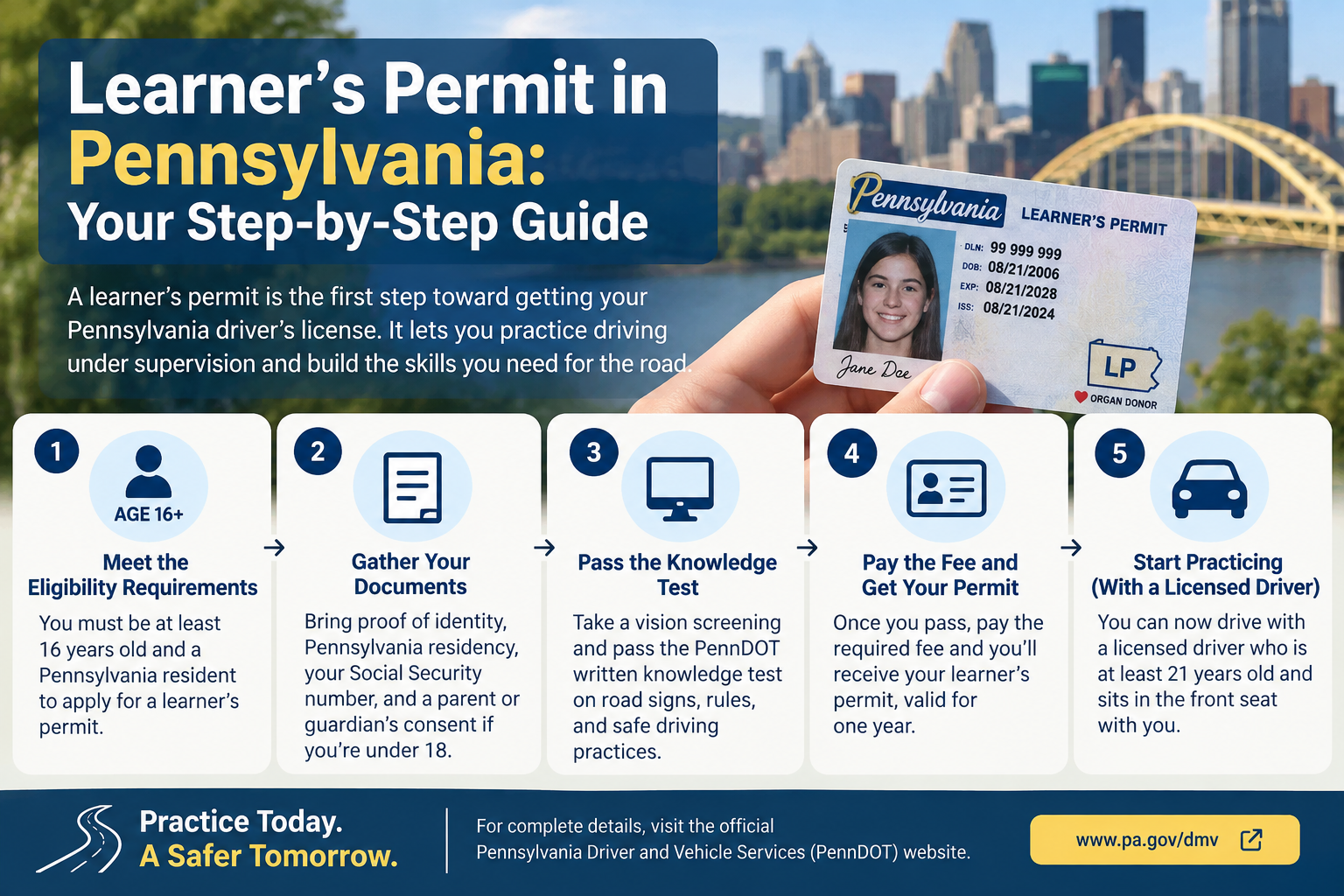
You have to be at least 16. After that, which rules apply depends on your age and your status.
If you’re 16 or 17
You’ll need a parent or guardian to sign Form DL-180TD. If they can’t come to the center with you, it has to be signed in front of a notary — a detail that has sent more than one family home to start over.
You’re also in Pennsylvania’s graduated licensing system: a six-month wait and 65 hours of supervised practice before you can take the road test.
If you’re 18 or older
Here’s something most adults don’t know, and it changes the timeline completely: the six-month wait and the 65-hour log don’t apply to you. Those are junior driver rules. Once you have your permit, you can book a road test as soon as you can genuinely drive.
What you do need is two proofs of residency — a lease, a utility bill, a mortgage statement, tax records, a W-2. Applicants under 18 don’t have to supply these. Adults do, and it’s the item adults most often arrive without.
If you’ve been putting this off, it’s worth saying plainly: nobody at the license center will find an adult applicant unusual, and the process is genuinely shorter for you than for the teenagers in line.
If you’re not a U.S. citizen
You can get a permit. Along with the standard paperwork, bring your passport and visa, your I-94, and your immigration documents.
If you don’t have a Social Security number, you’re not blocked. Go to a Social Security office and ask for an SSN rejection letter — a document confirming you aren’t eligible for a number. This is accepted in place of a card, and requesting it doesn’t affect your ability to get an SSN later if your situation changes.
One thing to check before you begin: drivers licensed in some countries may be able to convert directly to a Pennsylvania license without starting from a permit at all. If you already drive at home, ask PennDOT before you fill in anything.
PA Learner’s Permit Requirements: What to Actually Bring
Turning up one document short is the most common wasted trip in this process. Bring:
- Form DL-180, completed — front by you, back by your health care provider
- Form DL-180TD if you’re under 18
- Original proof of date of birth and identity — birth certificate or passport
- Your signed Social Security card, or a rejection letter
- Two proofs of residency if you’re 18 or over
- The fee, in a payment method your center accepts
- Your glasses or contacts, if you wear them
Two things worth saying twice.
Everything must be an original. Not a photocopy, not a scan, not a photo on your phone. PennDOT is strict about this and doesn’t make exceptions.
Check that your Social Security card is signed. People carry an unsigned card for twenty years without noticing, and it will get you turned away at the counter. Sign it before you leave the house.
Step 1: The Physical Exam — and the Mistake That Costs Months
Before anything else, a health care provider has to complete the back of your DL-180.
Now here’s the part nobody warns you about, and it’s the most expensive misunderstanding in the whole process.
Your permit is valid for one year from the date of your physical exam — not from the day the permit is issued.
Work through what that means:
You get your physical on March 3. Life gets busy, and you don’t make it to a PennDOT center until August 20. Your permit is handed to you that day — and it expires the following March 3, not the following August.
You’ve just spent five and a half months of a twelve-month permit doing nothing.
For an adult that’s an inconvenience. For a 16-year-old it can be the whole ball game: six months of mandatory waiting plus 65 hours of practice, starting from a permit that now has six and a half months left on it. Run out of time and you’re paying again and starting over.
So: get the physical, then go to the license center. Days, not months.
One extra rule if you’re applying right at 16 — the exam can’t be done earlier than six months before your 16th birthday.
Step 2: Fill Out the DL-180
The DL-180 is the Non-Commercial Learner’s Permit Application. You complete the front; your health care provider completes the back.
Under 18, add the DL-180TD consent form.
Bring the originals with you. PennDOT won’t accept these by mail for a first permit, and photocopies are refused at the counter.
Step 3: What It Actually Costs
There are two costs here, and almost every guide online mentions only one.
The PennDOT fee. The department’s published driver licensing fee chart (dated July 2025) lists the initial permit at $45.50 — and this is where a genuinely useful detail hides that nobody explains.
That fee is listed as “Initial Permit & 4-Year License.” It’s a bundled charge. You pay it once, at the permit stage, and it covers both the permit and the four-year driver’s license you’ll be issued after you pass your road test. You are not going to be charged a second, similar fee later.
PennDOT’s chart also lists no separate fee for the knowledge test or the road test. If you’ve been told the road test costs money, that’s a private third-party testing center, not PennDOT.
The physical exam. This is separate, and it’s the cost people don’t budget for. Your health care provider completes the back of the DL-180, and they may charge for that visit — it isn’t covered by the PennDOT fee. Ask what it will cost when you book, and check whether your insurance covers it.
One correction worth making: you’ll see $35.50 quoted on a number of driving school websites. That figure is out of date. Check PennDOT’s current fee chart before you go, and check which payment methods your center takes — not every location accepts every card.
Step 4: The Learner’s Permit Knowledge Test
The test is taken in person at a PennDOT Driver License Center. There is no official online version, whatever the practice-test websites imply.
The format: 18 multiple-choice questions on traffic signs, Pennsylvania driving laws, and safe driving practices. You need 15 correct to pass.
That’s worth translating: you can miss three questions and pass. Miss four and you don’t. Most people who fail do so on signs — not because signs are hard, but because they’re the part everyone assumes they already know and skips while studying.
The Test Is Offered in 30 Languages
This is the most useful fact on this page, and almost nobody knows it.
PennDOT gives the knowledge test in written and audio format, on request, in thirty languages:
Albanian · Amharic · Arabic · Bosnian · Burmese · Cambodian · Dari · English · Farsi · French · Greek · Hindi · Italian · Japanese · Korean · Mandarin · Mandinka · Nepali · Pashto · Polish · Portuguese · Punjabi · Russian · Somali · Spanish · Swahili · Turkish · Ukrainian · Urdu · Vietnamese
The audio option matters even more than the translation. If you speak a language comfortably but read it slowly, you can have the test read aloud to you.
We’re based in Northeast Philadelphia, where a good number of the languages on that list are spoken daily. If a written English exam is the reason you’ve never applied, it doesn’t have to be — ask for your language at the counter when you arrive.
If You Don’t Pass
You can take the knowledge test once per day — and that’s once per day in total, not once per location. Driving to a different center won’t buy you a second attempt.
You can come back the next business day. Keep your paperwork; you won’t have to redo the forms or the physical.
If you do fail, spend that evening on Chapters 2, 3 and 4 of the Pennsylvania Driver’s Manual, which contain sample questions with answers. One focused evening on road signs is usually the difference.
Step 5: The Eye Screening
There’s a vision screening at the center, unless your health care provider already completed it on your form.
Bring your glasses or contacts and wear them for the screening. If you need correction to meet the standard, your permit is issued with a corrective lens restriction — that’s routine, it isn’t a mark against you, and it simply means you wear them when you drive.
What You Can and Can’t Do With a Learner’s Permit in Pennsylvania
You’ll walk out with your permit the same day you pass. From that point:
- You must have a licensed driver aged 21 or older with you — or a parent, guardian, or spouse
- That person must sit in the front passenger seat, not the back
- You can’t carry more passengers than there are seat belts
- Everyone wears a belt
The supervision rule is the one people get casually wrong. A licensed 19-year-old sibling doesn’t qualify. Someone dozing in the back seat doesn’t qualify. The 21-plus driver has to be in the front, awake, and able to take over.
What Comes After Your Permit
If you’re under 18
Two things have to happen before you can take the road test: six months from the date your permit was issued, and 65 hours of supervised practice — including at least 10 hours at night and 5 hours in poor weather. A parent or guardian certifies those hours on Form DL-180C.
Once you pass, you’ll hold a junior license with its own rules: no driving between 11 p.m. and 5 a.m. (with narrow exceptions for work or volunteer service), and for the first six months, no more than one passenger under 18 who isn’t immediate family unless a parent or guardian is in the car. After six crash-free, conviction-free months that rises to three.
There’s also a route to an unrestricted license before 18: twelve consecutive months crash-free and conviction-free, plus an approved driver education course, submitted on Form DL-59.
If you’re 18 or older
No waiting period. No log. No junior restrictions. Book the road test when you can actually drive — and be honest with yourself about when that is, because the test doesn’t grade effort.
When you get to that stage, where you test matters more than most people expect. We’ve written a full guide to Philadelphia road test locations covering which centers do road tests, what to bring, and why a suburban site is often the easier choice.
Getting Your Learner’s Permit in Philadelphia
One distinction worth getting straight before you set out: the knowledge test happens at a Driver License and Photo Center. That is not necessarily where you’ll take your road test later. People conflate the two constantly and lose a morning to it.
Use PennDOT’s Find a Location page for current addresses, hours, and which services each center offers. PennDOT doesn’t publish direct phone numbers for individual centers, so check online rather than trying to call ahead.
Two practical notes from taking students to these centers for years. Many centers run Tuesday to Saturday rather than a standard week, so confirm the days before you plan around them. And mid-morning midweek is consistently calmer than any Saturday — if you have flexibility, use it there.
Frequently Asked Questions
How old do you have to be to get a learner’s permit in Pennsylvania?
16. Under 18, you’ll need parental or guardian consent on Form DL-180TD.
How much does it cost?
PennDOT’s published fee chart lists $45.50 for the initial permit, bundled with your four-year license, and shows no separate charge for the knowledge test or road test. Your physical exam is a separate cost and your health care provider may charge for it.
Can I take the knowledge test online?
No. Practice tests are online; the official test is in person at a Driver License Center.
How many questions are on the test?
18 multiple-choice questions. You need 15 correct — so you can miss three.
What if I fail?
You can retake it the next business day. One attempt per day, at any location.
How long is a Pennsylvania learner’s permit valid?
One year from the date of your physical exam — not from the day it was issued.
Do adults have to wait six months before the road test?
No. The six-month wait and the 65-hour practice log apply only to applicants under 18.
Can I take the test in a language other than English?
Yes — 30 languages, written or audio, on request.
What if I don’t have a Social Security number?
Ask the Social Security Administration for a rejection letter, which is accepted in place of a card.
Who can supervise me while I drive on a permit?
A licensed driver aged 21 or older, or a parent, guardian or spouse — seated in the front passenger seat.
Once You Have It
A permit is permission to learn. It isn’t a plan for learning, and the habits formed in the first few hours behind the wheel are usually the ones that stick — which is the honest argument for not making those first hours a parent shouting in a grocery store parking lot.
Five Stars Driving School has taught Philadelphia drivers for over 25 years: teenagers starting out, adults who put it off for a decade, and people driving in an American city for the first time. Our 2-hour lesson is a sensible first step, and if you’re under 18 those hours count toward your 65. If the whole idea makes you nervous, our Nervous Drivers Program exists precisely for that — it’s a large part of what we do.
Call 862-777-0191 and we’ll help you map out the route from permit to license.
About the Author
Angel is the owner and lead instructor of Five Stars Driving School in Northeast Philadelphia. He has taught new and returning drivers — teenagers, adults returning after decades away, and newcomers to the United States — for more than 25 years.
How We Verified This Guide
Ages, forms, documents, fees, test format and languages, retest rules, permit validity, supervision requirements and junior license restrictions all come from PennDOT’s published guidance and fee charts, linked throughout. Practical observations are our instructors’ own and identified as such.
PennDOT procedures and fees change, and the fee chart cited here is dated July 2025. Confirm current details with PennDOT before you travel to a center. Last verified: September 2026.
Also useful: Pennsylvania driver’s license types explained and Philadelphia road test locations.