

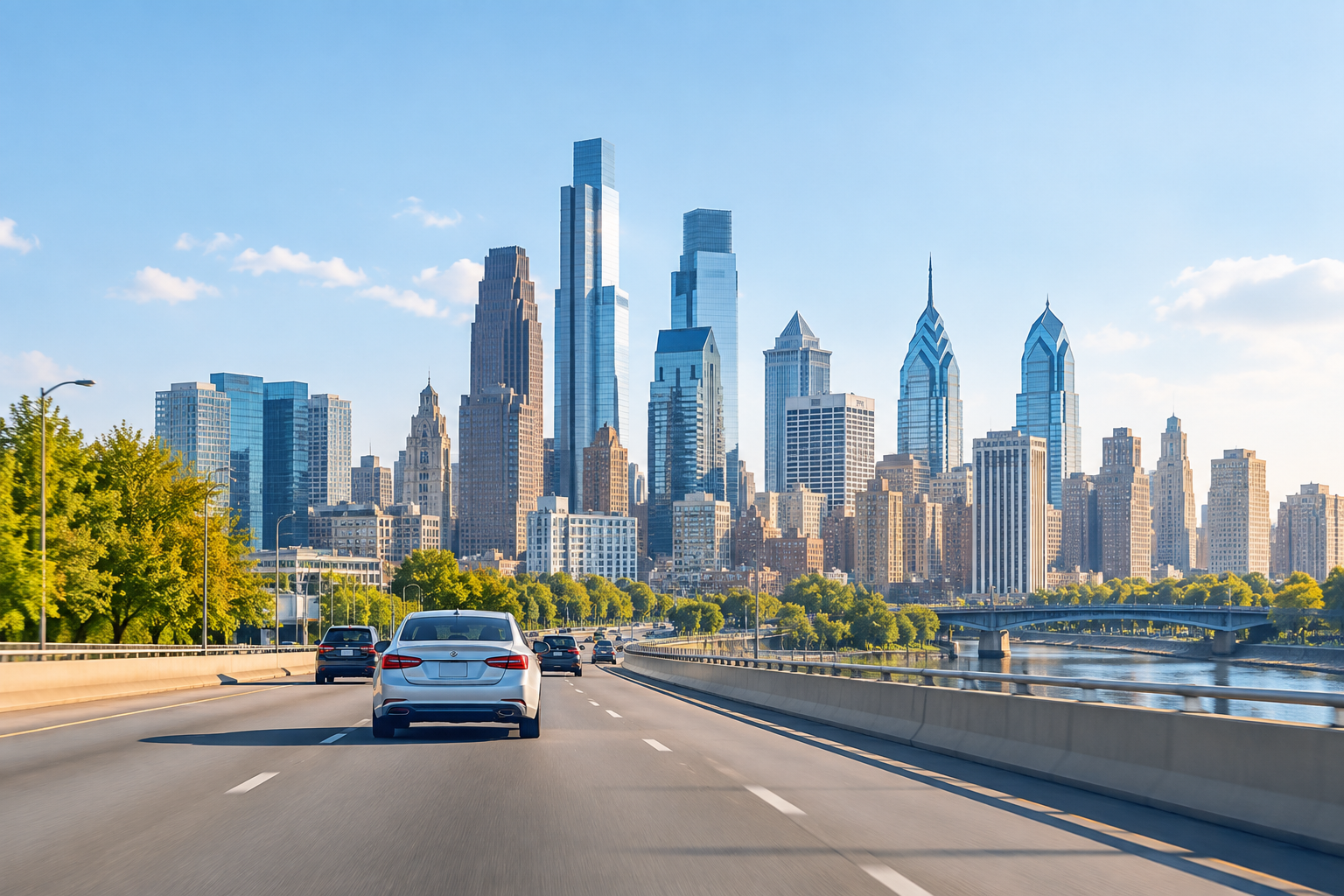
Most advice about driving in Philadelphia is written for people who don’t live here — rental companies writing for tourists, forum threads asking whether it’s safe to drive downtown for a weekend, locals being funny about everyone else. Useful if you’re visiting. Useless if you passed your road test last week and start a job on Monday.
This one is for you: real driving tips for the situations that actually catch new drivers here, including narrow street parking in Philadelphia, the Boulevard, highway merges, and which tickets cost money versus which cost your license.
It’s also for anyone who transferred a license from another state and discovered that holding a valid license and being able to drive here are two different things.Most advice about driving in Philadelphia is written for people who don’t live here — rental companies writing for tourists, forum threads asking whether it’s safe to drive downtown for a weekend, locals being funny about everyone else. Useful if you’re visiting. Useless if you passed your road test last week and start a job on Monday.
This one is for you: real driving tips for the situations that actually catch new drivers here, including narrow street parking in Philadelphia, the Boulevard, highway merges, and which tickets cost money versus which cost your license.
It’s also for anyone who transferred a license from another state and discovered that holding a valid license and being able to drive here are two different things.
What the Internet Gets Wrong About Driving in Philadelphia
Something needs saying before the practical part.
The most-read guide to this city tells readers that double yellow lines are “largely ignored,” that you should treat stop signs cautiously because other people roll through them, and that “every lane is a potential turning lane.”
As a description of what you’ll see out there, it’s not wrong. As instruction, it’s expensive.
The same page also claims Roosevelt Boulevard has 28 lanes. It has 12. That’s the level of accuracy in the page currently ranking first for this topic.
Here’s the version worth keeping: expect other drivers to break the rules, and drive so that it doesn’t hurt you when they do. That’s a completely different instruction from “do what they do.” One tells you to join in. The other tells you to leave yourself room.
Everything below follows from the second one.
Driving Tips for Philadelphia’s Narrow One-Way Streets
This is what surprises every driver arriving from a suburb or another state. Enormous stretches of this city are one-way residential streets barely wider than a single car, lined with parked vehicles on both sides and mirrors folded in.
Nothing on the road test prepares you for it. Nothing in the driver’s manual describes it.
How to pass a double-parked car
It’ll happen on your first drive. Someone has stopped in the only lane — hazards on, making a delivery, running in for two minutes.
The instinct is to swing out and get past before the car behind you gets impatient. Don’t.
The sequence:
- Stop short of it — far enough back that you can see past it, not nosed up against its bumper
- Look for three things: oncoming movement, a door about to open, someone stepping out from in front of it
- Commit or wait. Decide before you move, then move once, slowly and deliberately
The driver behind you will not enjoy step one. That’s fine. The most common new-driver collision on these streets is a rushed pass into a door that just opened — and that door opening isn’t your fault right up until the moment you’re going too fast to stop.
When the street is genuinely too narrow for two cars
On some blocks two cars physically cannot pass each other. The local convention is that whoever is nearer a gap pulls into it and waits.
If that’s you, do it early rather than at the last possible second. If it isn’t you, hold where you are and don’t creep forward — creeping removes the other driver’s room to solve the problem, and now neither of you can move.
The habit underneath all of this: on a narrow street, drive slowly enough that you could stop within the distance you can actually see. Between parked cars on both sides, that distance is far shorter than it feels.
Narrow Street Parking in Philadelphia
Parallel parking is the part of the test everyone dreads. Then real life turns out harder than the test — because on the test, nobody is waiting behind you.
Parking with a car waiting behind you
This is the situation that undoes new drivers more than any other.
Signal before you stop. Put your turn signal on while you’re still approaching the space, not after you’ve pulled up alongside it. It tells the driver behind exactly what’s about to happen and buys you patience you otherwise won’t get.
Then take the time you need. A driver who waits an extra eight seconds is a driver who waited. A driver whose impatience made you clip a bumper is an insurance claim with your name on it.
And reset if it isn’t working. Pull forward and start the maneuver again. This is normal — even the road test allows adjustments, which should tell you how often it’s needed. We’ve written separately about the common mistakes on the driving test, and parallel parking leads that list for exactly this reason.
What actually gets you towed
The folklore about parking here is entertaining. The expensive part is duller:
- Street cleaning. Posted signs give the day and hours. A car left in the zone gets ticketed and can be towed. Read the sign on the block you’re parking on — not the one you remember from the block before.
- Residential permit zones. Large parts of the city require a permit for extended parking. Visiting a friend for an afternoon in a permit zone is how most people collect their first ticket.
- Too close to a corner, a hydrant, or a crosswalk. Space is tight enough here that the temptation is real, and these are the easiest tickets the Parking Authority writes.
Build the habit of reading the sign every single time, even on a street you park on daily. Signs change, and the Authority doesn’t grade on familiarity.
Roosevelt Boulevard, Explained Properly
Most guides tell you to avoid the Boulevard. If you live in Northeast Philadelphia, that isn’t advice — it’s your neighborhood. So here’s what’s actually happening on it.
The facts, since they’re reported badly. Roosevelt Boulevard is 12 lanes wide, with posted speed limits of 40 and 45 mph. Reporting has put its traffic at roughly 100,000 trips a day, with about 700 crashes and 10 deaths annually — figures from a few years back, so treat them as scale rather than a current count. Traffic engineers have described it as a suburban highway dropped into a city, which is the most accurate explanation of why it feels wrong to drive.
The part that matters: the Boulevard is split into local lanes and express lanes. The crashes cluster around drivers moving between them — late lane changes, several lanes at once, people realizing too late that they’re in the wrong set.
Which gives you four rules.
Know which set you need before you get on. Turn coming up soon? Local lanes, early. Going a distance? Express lanes, and stay there. That decision belongs at the start of your trip, not two blocks before your turn.
One lane at a time, with a pause between each. Signal, check, move, settle, then think about the next one. Crossing three lanes in one sweep is the signature Boulevard maneuver and the reason those numbers look the way they do.
Be willing to miss your turn. This is the most useful sentence on this page. If you’re in the wrong lanes and your exit arrives, go past it and come back. Nearly every serious Boulevard crash starts with a driver deciding not to miss their turn.
Know the cameras are real. A peer-reviewed study of the Boulevard’s speed cameras found speeding violations fell by over 90% and crashes by about a third. They aren’t a deterrent you get to test — they work, which means they’re issuing a lot of tickets to people who didn’t know they were there.
Merging Onto I-95 and the Schuylkill
Two of the busiest highways in the region, both with short on-ramps and traffic already moving faster than you’d like.
The mistake is merging too slowly. New drivers reach the end of the ramp at 35 mph and start hunting for a gap. That’s far more dangerous than matching traffic — a car doing 35 joining traffic doing 60 isn’t merging, it’s an obstacle.
Use the whole ramp to get up to speed. Pick your gap while you’re still accelerating. Move in decisively. Hesitating halfway down the ramp spends the runway you need.
The Schuylkill adds a complication: several exits and entrances arrive quickly and close together, with short merge areas between them. Know your exit before you’re on it, because reading signs while judging a merge is one job too many when you’re new.
If high-speed merging is the specific thing you’re avoiding, practice it deliberately with someone experienced beside you before you do it alone in rush hour. A custom lesson built around one merge is a very normal request.
Cameras, Tickets and Points — What Each One Actually Costs
Philadelphia runs more automated enforcement than most new drivers realize. The Parking Authority lists speed cameras, red light cameras, and automated bus lane and trolley lane enforcement.
The bus and trolley lane cameras catch a lot of new drivers, because easing into a bus lane to get around a stopped car feels like nothing at all. It’s a ticket in the mail.
Camera tickets and officer tickets are not the same thing
Here’s the distinction nobody explains, and it matters more than anything else in this section.
In Pennsylvania, an automated camera citation is generally a civil penalty issued to the registered owner of the vehicle rather than a moving violation against the driver. As a rule that means no points on your license and no effect on your insurance. It costs money. That’s what it costs.
An officer-issued ticket is a moving violation, and moving violations carry points. Points are what suspend licenses.
So the mental model is: cameras cost you money, police cost you your license. Both are worth avoiding — but if you’re under 18, the second one is the one that ends your driving year.
Check the citation itself if you ever receive one, since the wording tells you which kind it is.
One thing cameras don’t forgive: the Parking Authority can boot a car, tow it, and have your vehicle registration suspended over unpaid violations. Ignoring camera tickets converts a money problem into a car problem.
If You’re Driving in Philadelphia on a Junior License
This deserves its own section, because your margin is thinner than everyone else’s on the road.
Under 18 in Pennsylvania:
- No driving between 11 p.m. and 5 a.m., except narrow work and volunteer exceptions
- For your first six months, no more than one passenger under 18 who isn’t immediate family, unless a parent or guardian is in the car — after six crash-free, conviction-free months, that rises to three
- Six points suspends your license for 90 days
Six points is closer than it sounds. Common moving violations — running a stop sign, speeding meaningfully over the limit, improper passing — carry points in the low single digits each, which means a couple of tickets can get you there. Not a pattern of bad driving. Two bad afternoons.
The drivers you see rolling stop signs around here have full licenses and years of accumulated margin. You don’t have that yet, which is why every habit in this article matters more to you than to anyone else out there.
Still working toward your license? Our guides to the learner’s permit in Pennsylvania and Philadelphia road test locations cover the whole process.
Four Habits That Make Driving in Philadelphia Safer
Strip away the specifics and it reduces to four things.
Leave more room than feels necessary. Every hazard in this city — the opening door, the pedestrian between parked cars, the driver crossing three lanes — is survivable with space and unsurvivable without it. Space is the only thing that buys you time.
Drive slowly enough to stop in the distance you can see. On a narrow street with cars parked both sides, that’s maybe two car lengths. Drive accordingly.
Decide early. Which lane, which exit, which set on the Boulevard. Almost every bad outcome here begins with a late decision rather than a wrong one.
Be willing to be the slow one. The driver behind you honking has no stake in your insurance, your license, or your afternoon. You have all three.
If you want to go further on technique, our guide to general driving tips and techniques covers the fundamentals, winter driving deals with the season that makes all of the above harder, and a defensive driving course is built around anticipating exactly the behavior this city specializes in.
Driving in Philadelphia: Frequently Asked Questions
Is driving in Philadelphia hard for new drivers?
Harder than suburban driving — narrow one-way streets, dense parking, heavy pedestrian traffic. It’s very learnable, but the specific skills aren’t the ones the road test measures.
What’s the hardest part?
For most new drivers, narrow residential streets with cars parked both sides, and parallel parking into tight spaces with traffic waiting behind them.
Is Roosevelt Boulevard really that dangerous?
It’s 12 lanes carrying very heavy traffic, and it has long been among the city’s worst roads for crashes. Most of the risk comes from drivers crossing between the local and express lanes. Driven deliberately — one lane at a time, decisions made early — it’s manageable.
Are there speed cameras in Philadelphia?
Yes, plus red light cameras and automated bus lane and trolley lane enforcement. A study of the Roosevelt Boulevard speed cameras found speeding violations fell by over 90% after installation.
Do camera tickets put points on your license?
Generally no. In Pennsylvania an automated citation is normally a civil penalty against the vehicle’s registered owner, so it doesn’t carry points or affect insurance. Officer-issued moving violations do carry points. Check your citation to see which kind you have.
How many points suspend a junior license?
Six points brings a 90-day suspension. A couple of moving violations can reach that, so the margin is small.
How do I avoid getting towed?
Read the sign on the block, every time you park. Street cleaning and residential permit zones account for most tows.
Should new drivers avoid highways at first?
Build up to them rather than avoid them. The riskiest version is a first solo merge in rush hour — practice it with someone experienced beside you first.
Getting Comfortable Here
None of this is about talent. It’s about having driven these specific situations once before you meet them alone.
Five Stars Driving School has taught Philadelphia drivers for over 25 years, on these streets. A custom lesson can be built around precisely the thing you’re avoiding — parking on a narrow street, merging onto I-95, the Boulevard. If you’ve been licensed a while and the city still rattles you, that’s what the Refresher Course is for. And if driving makes you genuinely anxious rather than just cautious, our Nervous Drivers Program is a large part of what we do.
Call 862-777-0191 and tell us which street you’re worried about. We probably know it.